

Some incidents don’t just shake a family — they redefine their understanding of protection.
This is one such story.
It was around 7:42 PM on what seemed like a normal Tuesday evening. Rohan was finishing some office work when he heard a sudden crash from his father’s room. He rushed in and found his father lying unconscious, gasping for breath, his hands cold, his pulse weakening. Panic replaced clarity. Fear replaced logic. Within minutes, he was dialing for an ambulance, shouting for help, trying to wake a man who had never looked so fragile.
As the ambulance sped through the traffic, sirens slicing through the noise of the city, the family held onto one hope — “He will survive… and our health insurance will support us.”
They had no idea what awaited them.
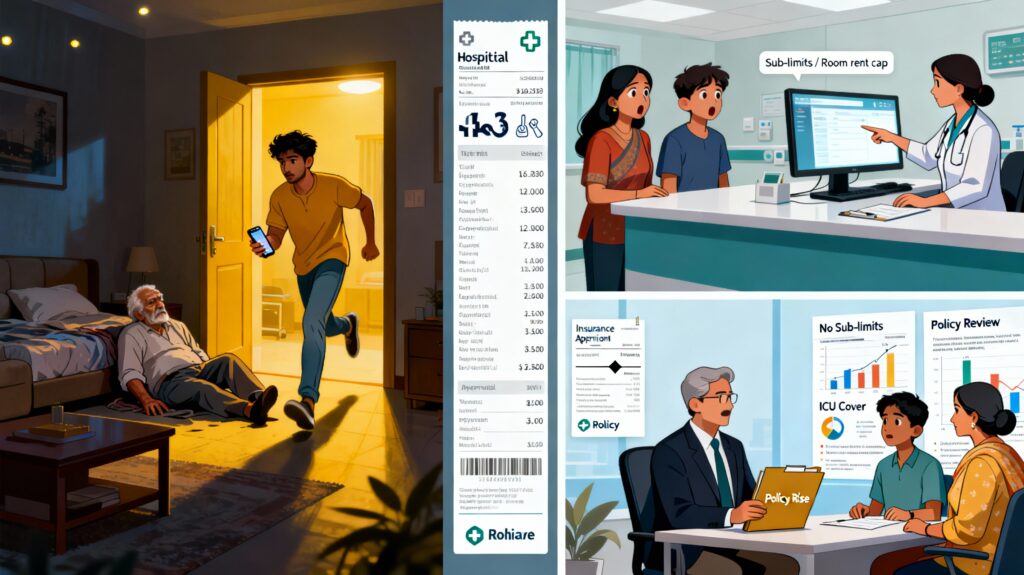
At the hospital, doctors immediately shifted his father to the ICU. High-risk cardiac complications. Oxygen support. Continuous monitoring. Multiple specialist consultations. The initial estimate shocked them: ₹1.8 lakh for the first 24 hours alone. But in that moment, money didn’t matter. Rohan only wanted his father alive.
When the hospital asked for the insurance card, the family took a deep breath. “This is why we pay premiums every year,” they thought. But calm lasted barely a few minutes.
The billing desk returned with a heavy silence.
Then the words that changed everything:
“Sir… your policy has room rent and ICU sub-limits. Cashless can’t be approved for this room.”
Rohan felt the floor slipping beneath him. He remembered buying the policy five years ago — a simple conversation, a quick signature, and a confident assurance from the agent: “Sir, this is full coverage. Sab cover hoga.” He never checked the fine print. Never reviewed the policy. Never upgraded the sum insured. Life was comfortable. Who reads clauses during comfort?
But real life doesn’t warn you before breaking you.
Treatment could not wait. ICU admission was compulsory. Ventilator charges mounted. Emergency medications kept increasing. Cardiologist and intensivist fees added up hour after hour.
By the end of the third day, the bill had crossed ₹6.8 lakh.
And the insurer approved only ₹2.1 lakh.
Room rent capping. ICU limits. Missing critical add-ons. No modern treatment coverage. Every clause worked against them. Every minute of that emergency became more expensive than the last.
They had to swipe cards repeatedly. Transfer savings. Borrow from relatives. Even take a small loan — just to keep the treatment going. In the middle of an emotional storm, they were drowning financially too.
The most heartbreaking moment came late at night when Rohan’s mother, exhausted and shivering, looked at her son and whispered:
“Humne socha tha insurance humara sahara hoga… par hum galat the.”
(“We believed insurance would support us… but we were wrong.”)
That sentence captures the harsh reality faced by thousands of families every year. It wasn’t a lack of insurance — it was a lack of insurance awareness.
This is why so many claims get reduced or rejected.
This is why families assume they’re “fully covered,” only to discover hidden sub-limits during a medical emergency.
This is why the right health insurance plan is not about premium — it’s about preparedness, protection, and peace of mind.
After weeks of treatment, Rohan’s father slowly recovered and returned home. The family felt relief — but also regret. They realized how easily this financial disaster could have been prevented if they had reviewed the policy earlier… if they had understood it better… if someone had explained the realities behind terms like room rent limits, ICU caps, co-payment clauses, and deductibles.
A few days later, Rohan called us, not with fear this time, but with determination.
His words have stayed with us:
“If someone had educated us earlier, we wouldn’t have gone through this pain. I don’t want any other family to face what we faced. Please help people understand their policies before life forces them to.”
And that is exactly why Policy Rise exists — to turn confusion into clarity, assumptions into awareness, and fear into preparedness. Not to sell policies, but to protect families through knowledge.
Awareness Takeaways From This Case
- A health insurance policy you don’t understand is a hidden risk.
- Sub-limits and room rent caps can drastically reduce your claim payout.
- Medical emergencies reveal the truth of your coverage — often too late.
- Reviewing your policy annually can save you from financial ruin.
Awareness is the real protection, not the policy document.
